
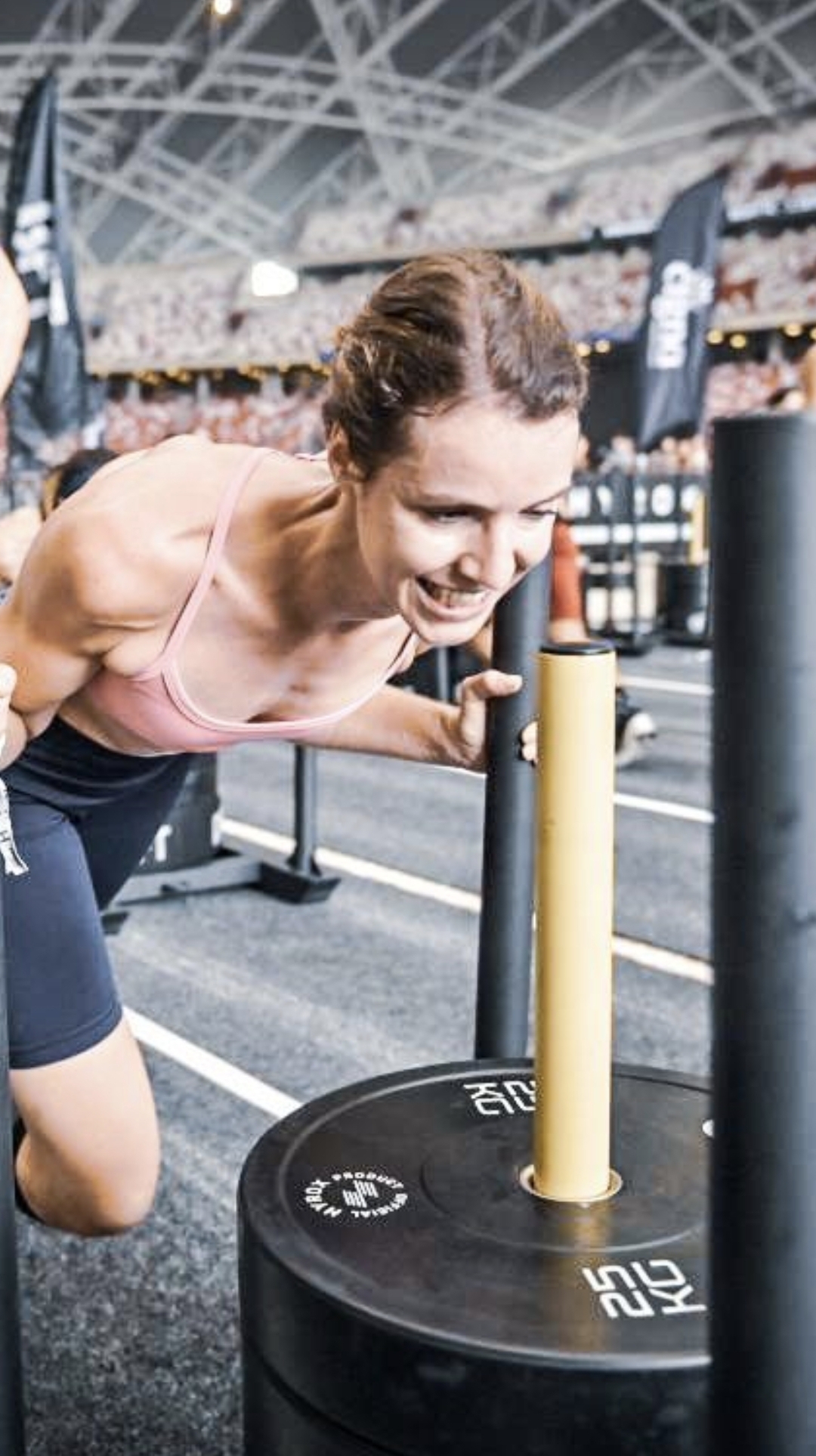
Yesterday a client told me, "But I'm too old for this." We were talking about Hyrox. My answer was simple: if you want to, and you're keen to try it out, you're OK. I know you can do it. There is no time limit.
We just need to practise the movements and prepare you for the strength part. And if you don't want to do it alone, you can do it in pairs or as a relay.
I hear "I'm too old" a lot from women in their 40s. Usually right when their body starts changing in perimenopause. So let's talk about why this might actually be one of the best times to start.
What is Hyrox?
Hyrox is a fitness race: 8 × 1km runs, with one workout station after each run. The running distance is the same in every division, 8km in total.
The eight stations, in order:
- SkiErg (1000m)
- Sled push
- Sled pull
- Burpee broad jumps
- Rowing (1000m)
- Farmers carry
- Sandbag lunges
- Wall balls
Two facts surprise most women:
- There's no time limit. According to Hyrox, the average finish time in 2024/25 was around 1.5 hours. Nobody is pulling you off the course.
- There's no upper age limit. You need to be 16 or older on race day. Age groups run all the way up to 85–89.
So no, you're not too old. The rulebook literally has a category for your mum.
Why Hyrox suits perimenopause
Hyrox training is strength plus conditioning, which is exactly what your body needs as oestrogen starts to drop.
- Bones: falling oestrogen speeds up bone loss. Heavy, loaded work like sled pushes, carries and lunges gives your bones a reason to stay strong.
- Muscle: we lose muscle faster from our 40s onwards. Strength training is the most effective way to hold on to it, and muscle supports your metabolism, joints and blood sugar.
- Heart: the running and rowing build your cardio fitness, which matters more as heart disease risk rises after menopause.
- Confidence: having a goal on the calendar changes how you train. You stop exercising "to fix" your body and start training for what it can do.
Perimenopause isn't a reason to slow down. It's a reason to train smarter.
Don't want to do it alone? Go Doubles or Relay
You don't have to do all eight stations yourself. Hyrox has team options that make it much less intense.
- Doubles: you and a partner run all 8km together and split the work at each station. You support each other the whole way.
- Relay: a team of 4. Each person does 2 × 1km runs and 2 stations. It's a great first taste.
- Women's Doubles also uses lighter weights than the Pro divisions.
A tip: in Doubles you choose who does what. If impact is tricky for you, your partner can take more of the burpee broad jumps while you do more sled or rowing. That's smart teamwork, not cheating.
Pelvic floor: burpee broad jumps, wall balls and running
These are the three parts of Hyrox that put the most load on your pelvic floor. That doesn't mean you avoid them. It means you prepare for them.
Wall balls: breathe out as you throw the ball up. Don't hold your breath. Start with a lighter ball or fewer reps, and practise them when you're already tired, because in the race they come last.
Running: start slow and pay attention to when symptoms appear. Is it after 5 minutes, after 20, or only when you're tired? That tells you where to build from. Run-walk intervals are a completely valid way to train.
Burpee broad jumps: this is the hardest one. Breathe out on impact, and build up step by step:
- Squat to calf raise (onto your toes)
- Small double-leg hops in place
- Small forward jumps with a soft landing
- Gradually increase the distance
- Add the burpee, then link reps together
My own backup plan: I'll be honest, I have one too. Period underwear, black leggings, and a liner if I'm worried. It's not a solution, just a safety net that lets you train with confidence while you work on the real thing. Ideally you prevent leaking rather than hide it.
See a pelvic floor physio first. Leaking isn't always a weak pelvic floor. Sometimes it's too tight (hypertonic). That's also why I'd be careful about jumping straight to pelvic floor chairs or endless kegels: if your pelvic floor is already overactive, they can make things worse. Get assessed, then train.
More on this in my post on the best exercise for menopause and a weak pelvic floor.
Other things to keep in mind in perimenopause
- Recovery: poor sleep and slower recovery are common now. Fewer, better sessions with plenty of strength work usually beat training hard every day.
- Joints and tendons: your fitness improves faster than your tendons adapt. Build up lunge, wall ball and running volume gradually, even when you feel ready for more.
- Singapore heat and haze: training in our humidity while dealing with hot flushes or night sweats is a lot. Hydrate well, pace yourself, and train early or indoors when you can. During haze season, check the PSI before outdoor sessions and move running and wall balls indoors when air quality drops into the unhealthy range.
- Your cycle: if your periods are becoming irregular, energy can swing from week to week. Adjust on the low days instead of forcing the plan.
I'm training for it too
I'm preparing for my own Hyrox Pro race at the end of November, fitted around three kids and a business. So I'm practising everything I've written here: the breathing, the progressions, the backup plan.
If you're thinking "I'm too old for this," I'd love to prove you wrong. We can prepare you for the movements, build the strength, and find a partner or team so you're not doing it alone.
Book a trial session with one of our coaches, and let's get you to that start line. And if you want the bigger picture on training through perimenopause, it's all in my book.
Leave a Reply